
Snyder Projected Versus Actual Release
A projected or expected date is a planning point based on the sentence and facts known at that time. An actual release date records when the person left a specific custodian. Pennsylvania's public PA DOC locator does not display a field literally labeled “Projected Release Date” or “Tentative Release Date.” Its state-inmate detail can show a Minimum Sentence Date, Maximum Sentence Date, and Parole Review Information.
The minimum date is the ordinary point at which a state prisoner first becomes eligible for parole. It does not compel the Board to grant parole. The maximum date is sentence expiration after lawful calculation, but another case, detainer, or legal change can affect where the person goes. On the locator's Department Supervised Individual side, Release Date means an actual release from state prison into current PA DOC supervision. It does not mean the whole sentence or supervision term has ended.
A pretrial detainee has no sentence-based release date. Bail action, dismissal, a plea, a detainer, or another court order may alter custody. For that person, read the UJS docket and call the current jail rather than applying a prison sentence formula.
Release and discharge are also distinct. Parole releases a person from prison while the balance of the sentence continues under supervision. Discharge is the formal end of the applicable sentence or supervision duty. A PA DOC supervised-person Release Date proves neither maximum-sentence completion nor release from a separate Snyder court condition.
Find Snyder Projected Release Dates
Begin with custody type because Snyder's distributed placement can separate the county case from the building that holds the person. Snyder Corrections may identify an outside placement at Clinton, Columbia, Union, or SCI Mahanoy. County boarding and PA DOC custody use different calculations and records.
- Search the UJS docket and identify whether the person is awaiting trial, serving a county sentence, or committed to state prison.
- Ask Snyder Corrections for the current physical custodian. Removal from a Snyder count can mean transfer, not community release.
- For state custody, open the PA DOC locator. Match the person and read the exact Minimum Sentence Date, Maximum Sentence Date, and review information shown.
- If state-prison release to parole is plausible, search the Department Supervised Individual side. A matching Release Date is evidence of release into current supervision.
- For a county sentence, obtain the sentencing order, credit for time served, county calculation, and physical jail release record. Do not apply state RRRI fields automatically.
- Confirm the event with the agency that executes the exit. Ask for date, time, authority, destination, and any transfer entry that already exists.
The full Snyder County released-inmate lookup supplies the broader path when neither state nor county sentence records resolve the person's current status. A federal or immigration case requires the BOP, ICE, federal docket, or actual holding facility instead.
When the locator returns no correct person, do not label the person released. The person may never have entered PA DOC, may have fully discharged, may be under county or federal authority, or may not match the search inputs. Use inmate or parole numbers when possible. Confirm name, date of birth, committing county, photograph, and current location before relying on a detail record.
Pennsylvania Minimum and Maximum Dates
Pennsylvania uses indeterminate sentences. Under 42 Pa.C.S. § 9756, the sentencing court ordinarily states a maximum and a minimum that cannot exceed one-half of that maximum. The minimum starts the ordinary parole-eligibility stage. The maximum marks sentence expiration. These two dates are the legal base for the fields shown in PA DOC detail.
Under 61 Pa.C.S. § 6137, the Pennsylvania Parole Board may grant parole only after the minimum has expired, and parole is not a right. Death and life sentences fall outside ordinary Board parole authority. A Board grant can also set conditions or await an approved plan. It is not a door timestamp.
Pennsylvania's official parole guidance rejects a common imported shortcut. State inmates are not generally required to serve 85 percent of the maximum sentence. Multiplying a maximum term by 0.85 does not produce an official Snyder County projected release date. The minimum date is also not guaranteed release.
The Board weighs statutory and institutional information after eligibility. Required conditions, program records, release planning, and an available home plan may affect execution. A minimum date can therefore pass without prison exit. The proper proof of a decision is the written Board Action, while the proper proof of leaving is the physical DOC event record.
Note: Read every date with its exact source label because minimum, maximum, release, and discharge describe different events.
Snyder Release Dates and RRRI
Pennsylvania does not give every prisoner universal day-for-day good time. The Recidivism Risk Reduction Incentive, called RRRI, is a limited statutory program. For an eligible person, the RRRI minimum generally equals three-fourths of an ordinary minimum of three years or less, or five-sixths when the ordinary minimum exceeds three years. Eligibility must come from the judgment and statutory process.
Title 61, Chapter 45, especially §§ 4503, 4505, and 4506, assigns roles to the sentencing court and PA DOC. Program and compliance certification plus a Board determination still matter. PA DOC's example of an 18-month RRRI minimum for a two-to-four-year sentence cannot be copied onto a Snyder case unless that person's judgment actually confers eligibility.
The official PA DOC RRRI explanation is captured below.
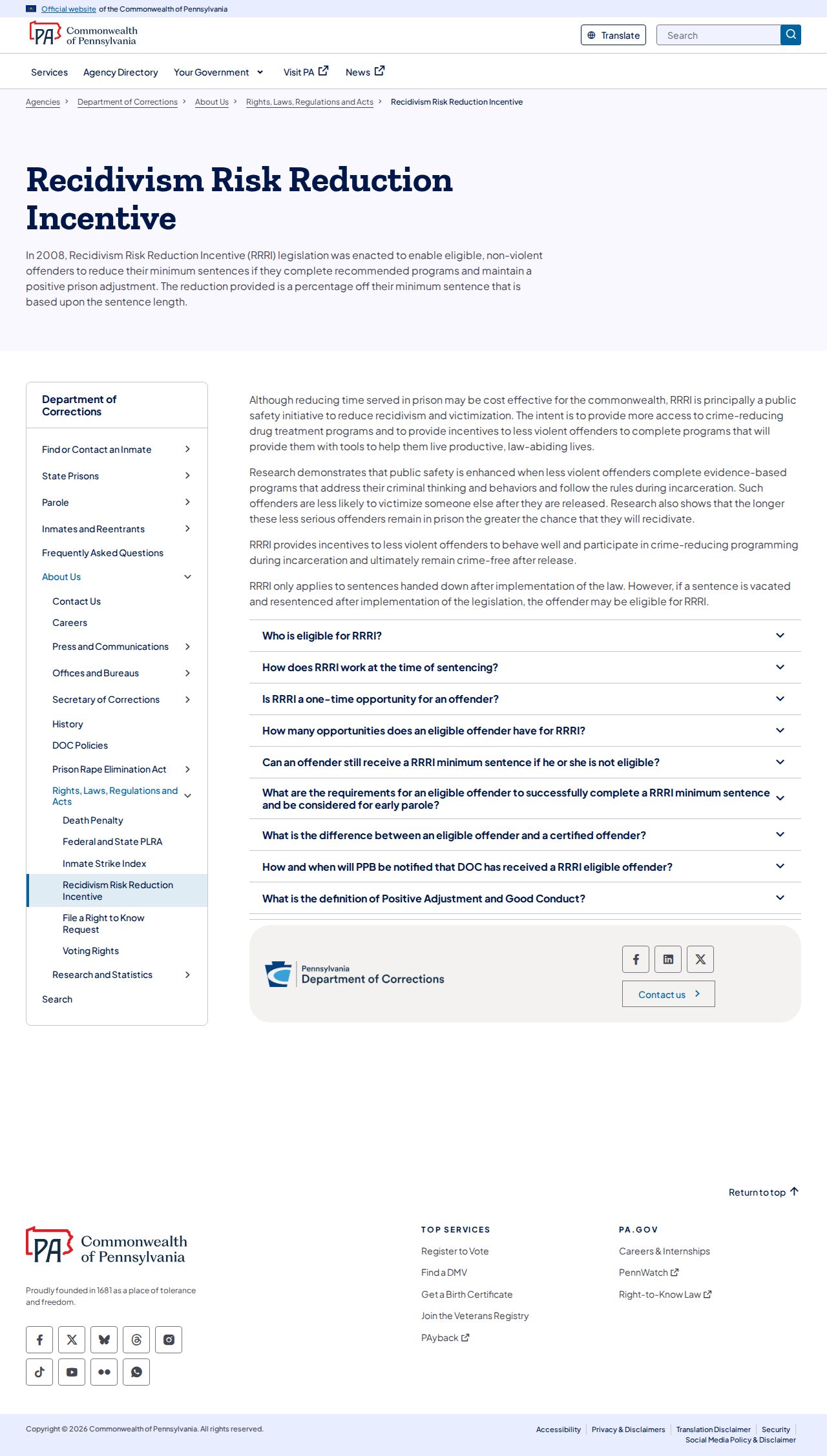
The source frames RRRI as an eligibility-based exception, not a blanket reduction that anyone can compute from the maximum date.
Why Snyder Release Dates Change
A date can move even when the first calculation was sound. PA DOC may recalculate credit or the relationship between consecutive and concurrent terms. Consecutive terms run one after another; concurrent terms overlap. A court can amend a sentence, and a parole violation can produce recommitment or backtime, which is custody imposed for that violation.
| Factor | Effect on release | Record to check |
|---|---|---|
| Credit recalculation | Changes minimum or maximum computation | DOC or county sentence calculation |
| Amended court order | Changes the lawful sentence or credited time | UJS docket and signed order |
| Parole decision | Grant, denial, or later review affects eligibility for community release | Written Board Action |
| Violation and backtime | Can return a parolee to custody or delay a new release | Violation decision and DOC calculation |
| Detainer or warrant | May cause transfer to another authority instead of community release | Issuing agency and receiving-custody record |
| Plan or program incomplete | Can delay execution after an approval | Board Action and institution record |
Administrative processing can continue after a grant. A home plan may need approval, a required program may remain incomplete, or another authority may arrange pickup. Therefore a projected date should always be paired with the latest Board Action, calculation, and custodian status.
Another authority may lawfully take custody at the door. A detainer can come from another county, PA DOC, federal authorities, or immigration officials. The first prison may record release even though the person does not enter the community. Ask for the destination and receiving agency when reviewing an exit record.
Snyder County Sentence Calculations
A county sentence does not become a state sentence merely because Snyder boards the person elsewhere. Use the sentencing order, credit for time served, the county's calculation, and the receiving jail's actual exit entry. State-prison RRRI and PA DOC locator fields do not automatically govern a person held on a local county judgment.
Snyder's placement structure adds a vital check. Snyder Corrections or the court may determine authority, while Clinton, Columbia, or Union County may execute the physical exit. A transfer to SCI Mahanoy is entry into state custody, not release. Ask each agency which event it recorded and compare identifiers, timestamps, and destination.
No verified Snyder source gives a fixed release hour, weekend advance-release rule, release door, or property-return schedule. Those facts must not be guessed. Call Snyder Corrections and the current physical custodian for the individual case, and do not treat published visitation hours as release-processing hours.
Credit for time served is the period a court or corrections calculation applies toward the sentence for qualifying prior confinement. Whether time counts depends on the actual order and lawful calculation. Do not estimate it from arrest and docket dates alone. Consecutive and concurrent terms can also change the total, so obtain the calculation rather than adding or overlapping terms without authority.
Snyder Parole Decisions and Timing
Board review has its own cadence. Pennsylvania guidance says institution interviews commonly occur months before the minimum date, and late files can move to a later monthly docket. No ordinary public person-name statewide parole-hearing calendar was verified. A listed review month, interview, or eligibility date should never be stated as a Snyder County release appointment.
The written Board Action records whether parole is granted or refused and can set terms for later execution. Institutional parole staff generally deliver and explain the notice under the Board's procedure. A grant can still await conditions, plan approval, detainer handling, or other processing. For precision, compare that action with PA DOC's sentence dates and the later physical release event.
Violation proceedings follow a different track. Recommitment and backtime can change a future release calculation, while a red “Wanted: Parole Absconder” label indicates wanted supervision status and not confirmed jail custody. Check the warrant, violation decision, latest DOC location, and sentence calculation together.
Confirm Snyder Actual Release Dates
A strong confirmation uses three records for three different questions. The sentence or Board Action explains why release could occur. The PA DOC or county calculation explains the relevant legal dates. The physical custodian's release or transfer record proves when the person left that agency and where they went next.
PA SAVIN through VINELink can provide prospective notice for participating county jails, state prisons, and state parole. Register against the correct person and preserve the exact wording of the alert. The Snyder County VINE inmate check explains the local registration route. An alert for transfer, movement, or escape must not be rewritten as a release.
For a state case, request the written Board Action, the current DOC calculation, and the release event. For a county case, obtain the Snyder order and calculation plus the outside jail's exit record when boarding occurred. Date each result. That method separates a planned date from an actual release and prevents one agency's transfer entry from being mistaken for return to the community.